
Prosperity 2030 UCL · IGP Prosperity 2030

National Contributions

Fair taxes that treat every pound the same

Revenue Instrument · economics
Tax cut for 72% FT waged workers
£723 / year, average
NC v Current, Wages only
New revenues
+£75 Billion / year
P2030 rates after 5 years
Fiscal Space Created
+1.4% GDP / year
P2030 rates after 5 years

National Contributions (NC) is the flagship revenue reform policy in the Prosperity 2030 programme. NC is much more than a mechanical re-arrangement of rates and flows, it is a reform designed to embody reciprocity and cement solidarity. The primary purpose is to strengthen the connection between the benefits and obligations of citizenship by making the reciprocal link clearer.

NC is a single tax on total personal income, replacing six current taxes, following a Progressive Rate On Flat Income, Linked to Everyone (PROFILE) design. The higher a person’s total income, the higher the rate of tax. The rates are anchored to the median income in the country, so rates are lower for half of all taxpayers, and higher for the other half with larger incomes. As median income changes, the system adapts automatically and mechanically.

NC is a tax on receipts. It does not differentiate between the type or source of the receipt. So long as it is a monetary value received, it is subject to NC in that year – that is what is meant by “Flat Incomes” in the PROFILE design. NC replaces Income Tax, Capital Gains Tax, Dividend Tax, Inheritance Tax, and Employee and Self-Employment National Insurance.

There are no ‘tax free’ allowances, all income received is subject to NC tax. Because everyone is a beneficiary of the country’s services and structures, so everyone makes a National Contribution from their private income. There is a level below which paying NC is voluntary, but if that contribution, however small, is paid, then that year counts as a “stamp” for the individual’s State Pension entitlement.

The government sets just two rates and a threshold: a Base Rate, a Top Rate, and the Voluntary threshold. The Base Rate is progressively applied up to the median income in the middle of the population. The Top Rate is then progressively applied from the median up the 90th percentile, and then flat on the top 10% of incomes. The result is a smooth, escalating rate profile from the lowest to the highest incomes, with no cliff edges and no steps.
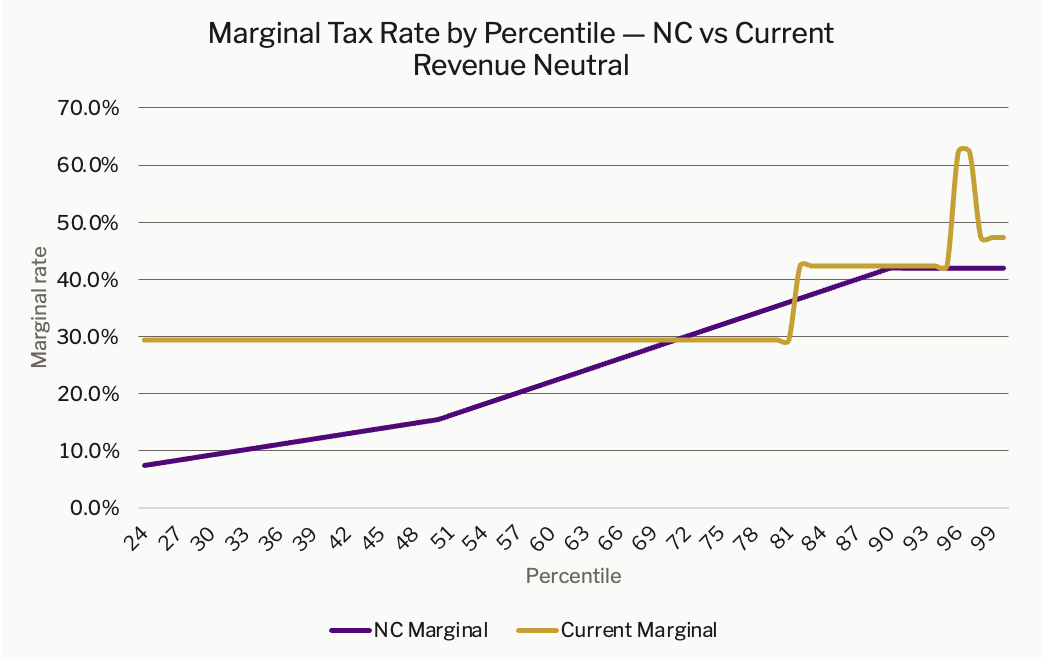
Marginal Tax Rates on Income NC v Current (2025)

This structure means that if your income falls relative to everyone else, your rate of tax will go down and you will pay less tax. Conversely, if your pay goes up and everyone else’s does not, then you will pay a higher rate of tax on your income next year.

From one perspective: the more a company pays their workers, the lower the boss’ taxes will be.

A simpler system of raising revenues has many additional advantages, including removing cliff edge disincentives and eliminating classification arbitrage. But the biggest gain from reform is breaking free from the gear-jam that prevents effective revenue policy. Governments complain that the levers of power are disconnected from the mechanics of government, but that is a feature of antiquated design, not a necessary configuration.

Revenues are needed to fund the required upgrades to social fabric, but those revenues are only available once taxation, especially personal income tax, has been simplified and restored as the principle of reciprocity on which the social contract rests.

Revenues

National Contributions raises tens of billions more than the six taxes it replaces, and the whole of that comes from taking a slightly larger share of total income, not from a charge on any one source. This is the point most often misread, so it is worth setting out as plain arithmetic.

£bn Share of income
Total personal income 1,912
Taken by the six taxes replaced 392 20.5%
Taken by National Contributions 470 24.6%
Net additional, matured 78 +4.1%
less inheritance still phasing in (five-year window) (3)
Net additional, in the programme window 75

The additional revenue is a little over four percentage points of a personal income base of about £1,900 billion. It is not a levy on capital or on wealth. The capital gains, dividend, and inheritance tax bases are too small to produce a sum of this size.

That increase has two parts. About two-thirds is the higher rate falling on income already taxed today: because the rate is set by a person’s total income, every pound of earnings, dividends, savings, and gains is charged at that combined rate rather than on its own schedule. About one-third is base-broadening. NC brings roughly £185 billion a year of inheritance and other irregular receipts into the income base, flows that today raise about £8 billion of Inheritance Tax and no income tax. Taxed as income to recipients and dispersed over the withdrawal window at moderate rates, that broader base accounts for the remaining third. The contrast is between taxing £185 billion of flows as income compared to the £8 billion currently collected on those flows.

By income level the effect is unambiguous and depends on no modelling assumption: about four-fifths of the additional revenue falls above the median, three-fifths on the top quintile, and two-fifths on the top decile, with the change close to neutral below the median. Most of the extra money is higher earners paying a higher rate on their total earnings, not a tax on wealth.

The Macro Cashflow carries the conservative in-window figure of about £75 billion, some £3 billion below the matured £78 billion, because inheritance revenues phase in over ten years and only the earliest cohorts fall inside the programme’s five-year frame. The Fiscal section states values as percentages of GDP because pound figures would carry real modelling uncertainty that obviates greater precision.

Rates

In the model used for this report, the Base Rate is set to 22% and the Top Rate is set to 46%. These rates cannot be directly compared to current Income Tax rates because the rates change as relative income changes, and NC also replaces other taxes, including employee NICs, Capital Gains Tax, and Inheritance Tax.

The rates selected for this report fund all parts of the P2030 programme, as well as creating the targeted fiscal space beyond the policies included in the programme. The main categories of expenditure funded from National Contributions are:

  • Universal Services
  • Stamp Duty abolition
  • Structural reforms
  • Fiscal space

1 for 6 : Tax Simplification

There are well documented problems with the UK’s current system of taxing incomes and gains1. Those are reasons enough to reform taxation. In addition, co-ordinating reforms of taxation with social support creates opportunities to tackle obstructions and disincentives in the wider tax system. Tax reform is needed any way, and this programme takes the opportunity to make those reforms.

National Contributions (NC) was first advanced in an IGP report2 in 2021 and this report adopts the same design principles: first change what is taxed, and then apply a simplified rate structure.

NC replaces six current taxes: Income Tax (IT), employee and self-employment NICs (NICS), Dividend Tax (DIV), Inheritance (IHT), and Capital Gains (CGT) taxes. NC eliminates these distinctions, reclassifying them all as income flows. That is the change to what is taxed.

NC applies a progressive rate structure to the flat definition that includes all income. The rates are anchored to the median income, providing stability and consistency. A Voluntary National Contributions (VNC) threshold sets the income below which remittance is voluntary, but if made, allows the year to qualify for State Pension entitlement. (The model used for P2030 does not rely on any revenues from incomes below the VNC threshold.)
Detail

The current system applies different rates and thresholds to different income types and earnings face both Income Tax (with a personal allowance, basic rate band, higher rate band, and additional rate band) and Employee NICs (with a primary threshold and upper earnings limit); capital gains face CGT (with an annual exempt amount and rates that differ by asset type and total income); dividends have their own rates; and inherited wealth faces IHT (with a nil-rate band and residence nil-rate band applied at the estate level). NC does away with those historic distinctions and applies a much simpler principle: anyone who receives income is taxed the same way.

Income Tax

Income Tax and Employee National Insurance Contributions are merged into NC.

All income from all sources is taxed equally progressively. Income from employment, self-employment, pensions, winnings, carried interest, and gains (with refinements of the current exemptions and allowances) are all treated equally. This removes distortions and complexity from the tax code, simplifying implementation, administration, and collection. Not only is the simplification helpful in reinforcing reciprocity, it also means that HMRC can reasonably implement NC in the PAYE system in one year.

Capital Gains Tax

Capital Gains Tax is replaced by NC, retaining current loss provisions.

Capital gains are assessed at disposal, with a deduction for inflation since the original acquisition of the asset (no uplift at death). The remaining gain is taxed, just like it would be as income.

Dividend Tax

Dividends are counted as ordinary income and included in NC, replacing the separate Dividend Tax schedule, in line with the priority to simplify tax and remove source classification arbitrage. Treating dividends identically to other income means distributed profit bears both corporation tax and NC. Relieving that double charge, so that genuine investment returns are not over-taxed relative to other income, is a design question for the implementation legislation rather than this report.

Inheritance Tax

Inheritance Tax is replaced by NC.

All inheritance is taxed as income to the recipients, not on the estate. Large gifts are treated the same: a gift received is taxed as income to the recipient, with the same National Savings shelter. The current gift exemptions continue, measured on the giver as now, so the annual exemption, small gifts and wedding gifts keep ordinary giving out of charge. The exemption for gifts out of surplus income is withdrawn, because it rises with the giver's income and lets the highest earners move large sums out untaxed year after year. A gift between spouses is not treated as inheritance until it is passed on, the same deferral that applies to a bequest.

The seven year rule disappears, and trusts are seen through to ensure they do not escape charge.

Tax sheltering in NS&I allows taxpayers to shelter inheritance received as cash (which is no longer taxed on the estate) until they withdraw it, at which point it is taxed at the rates that apply to any other income in that year.

Tax Shelter in National Savings

NS&I will designate various of their accounts as tax sheltered National Savings accounts. Funds in those accounts are sheltered from taxation until withdrawn, with the same dispersion window applying to sheltered balances on the same basis as inheritance, so that sheltering defers the point of charge but not the liability.

This allows taxpayers to shelter lump sums of income, such as inheritances, from single year NC rates and distribute their income over time, taxed at their NC rate for the year in which they access the funds. During this time they have in effect lent the deferred liability to the government.

NC in the P2030 Programme

NC starts in Year 2 of the programme to allow for changes in legislation and IT system updates. The Base Rate for P2030 is set at 22%, the Top Rate at 46%, and the Voluntary NC threshold is set at £12,570 — mirroring similar rates and thresholds in the current system.

Most taxes are collected from payroll via PAYE and so those revenues start immediately, adding £52 billion (1.9% of GDP) in Year 2. After four years, as various components phase in, the total additional revenue will rise to around £75B (2.8% of GDP).

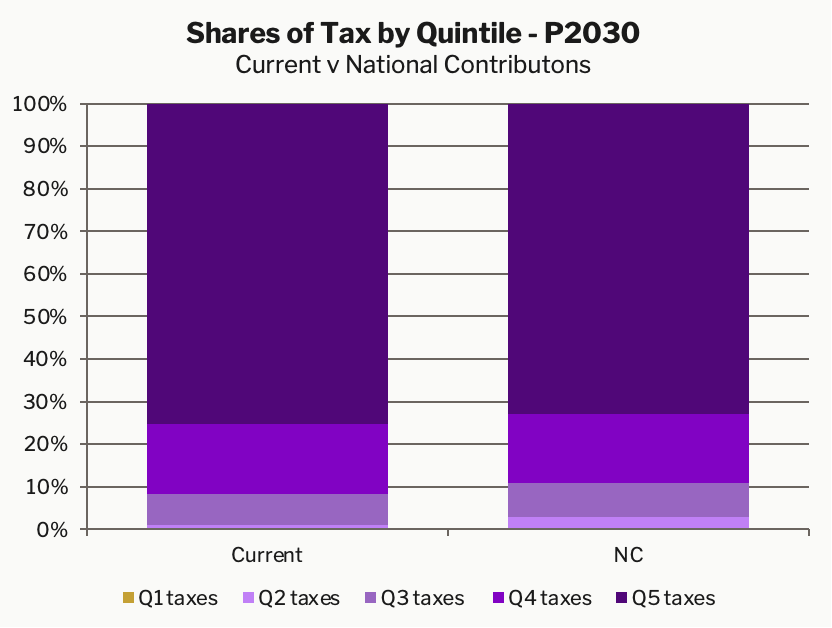
Shares of tax by Quintile

The chart above shows each quintile’s share of total income tax. Higher earners pay more in absolute terms than under the current system, with the top quintile alone contributing about £48 billion of the £78 billion increase. But because the base is broader and the total larger, the top quintile’s share of the whole falls by about two percentage points. Higher incomes pay more, while the overall burden is spread a little more evenly.

Stamp Duty revenue replacement

National Contributions also carries the revenue lost when Stamp Duty Land Tax is abolished. The new Property Tax is collected nationally but committed in full to local government, so it does not backfill the £10 billion that Stamp Duty raises today; that gap is met from the National Contributions base instead. This is a deliberate improvement rather than an artefact of accounting. Stamp Duty is a transaction tax that penalises moving home and is widely judged one of the most economically damaging taxes in the system. National Contributions is a broad, progressive tax on all income. Replacing the first with the second removes a distortion that suppresses housing mobility and raises the same revenue from incomes, rather than a chance move. Carrying this replacement is one of the obligations the National Contributions rate is set to meet, alongside funding the Universal Services and creating fiscal space for other national priorities.

Reciprocity Hypothecation

Making a broad, public commitment of NC revenues to Universal Services creates strong reciprocity. This is a public declaration that all taxes paid by citizens on their incomes are assigned to delivering public services for citizens. Failure to make those contributions (paying those taxes) is a direct detraction from everyone’s safety and security.

In the P2030 model, total revenues from NC are about £470 billion, and current expenditure on existing public services in 2024 was about the same. P2030 adds another £50Bn in Universal Services, so it would be accurate to say that ‘all NC revenues are spent on public services’.

The consolidation of various income taxes into NC allows hypothecation without reducing the flexibility of general revenues. The 2021 NC report demonstrated a model assignment of revenues and spending that shows that this broad hypothecation is politically credible without changes in budget administration.

Tax Year is a Calendar Year

The introduction of NC provides an opportunity to further simply the tax system by aligning the tax year with calendar years. Given that HMRC will be making significant changes to their systems for NC, consideration should be given to taking the chance to make this calendar change at the same time.

  1. Adam, S. and Miller, H. (2021), Taxing work and investment across legal forms: pathways to well-designed taxes, IFS Report R184, Institute for Fiscal Studies, London. https://ifs.org.uk/publications/taxing-work-and-investment-across-legal-forms-pathways-well-designed-taxes
  2. Percy, A. (2022) National Contributions: Reforming tax for the 21st century. Available at: https://discovery.ucl.ac.uk/id/eprint/10138866/ (Accessed: 10 March 2026).

Published 18 May 2026