Prosperity 2030 UCL · IGP Prosperity 2030

Universal Energy Service

Energy is life: save it for the next generation

Universal Service · energy, housing
Max Free Energy tier per home
13,800 kWh / year
E+ EPC rated homes
Annual Energy Bill
£0
Households using below allowance
Cost of Living Reduction
£505 / year
Household average (tiered & weighted)

One of the most intractable aspects of policy in recent years has been the tension between energy costs and the need to transition to more sustainable and secure energy sources. Populist groups across Europe have zeroed in on spiralling energy costs as a way of inciting dissatisfaction with prevailing political and economic policies. This is unnecessary, and prevents progress on urgent transformations of society and economy.

The Universal Energy Service achieves three objectives in a single policy. It drives down household energy costs; rewards careful energy use; and it moves the costs of the energy transition from consumer bills to national taxation.

Free Tier

The programme removes all standing charges from domestic energy bills and provides a Free Tier basic energy allowance that insulates a third of households from consumption charges.

Every household gets 66% of a health-based comfort standard applied to a typical dwelling (13,800 kWh), plus another 15% for each child up to a maximum of two children. Usage above that level is charged at 3.37 times the current rates split between electricity and gas. Off-gas-grid homes can choose a fuel voucher or take all of their free tier as electricity.

Each element enables and depends on the others. Moving the system costs in standing charges off bills allows the suppliers to provide free tiers. The free tier stimulates energy efficiency. The efficiency saves households and the nation money. Without the design, sequencing, and taxes, the policy is impossible.

Households that keep their energy use low will make the most of their Free Tier. If they get their use below their allowance, they will not be billed for their energy use: £0 annual energy bill, worth £1544 (on average, at 2026 cap rates). Households that make no efficiency savings will still benefit from a reduction thanks to the elimination of standing charges (average £310).
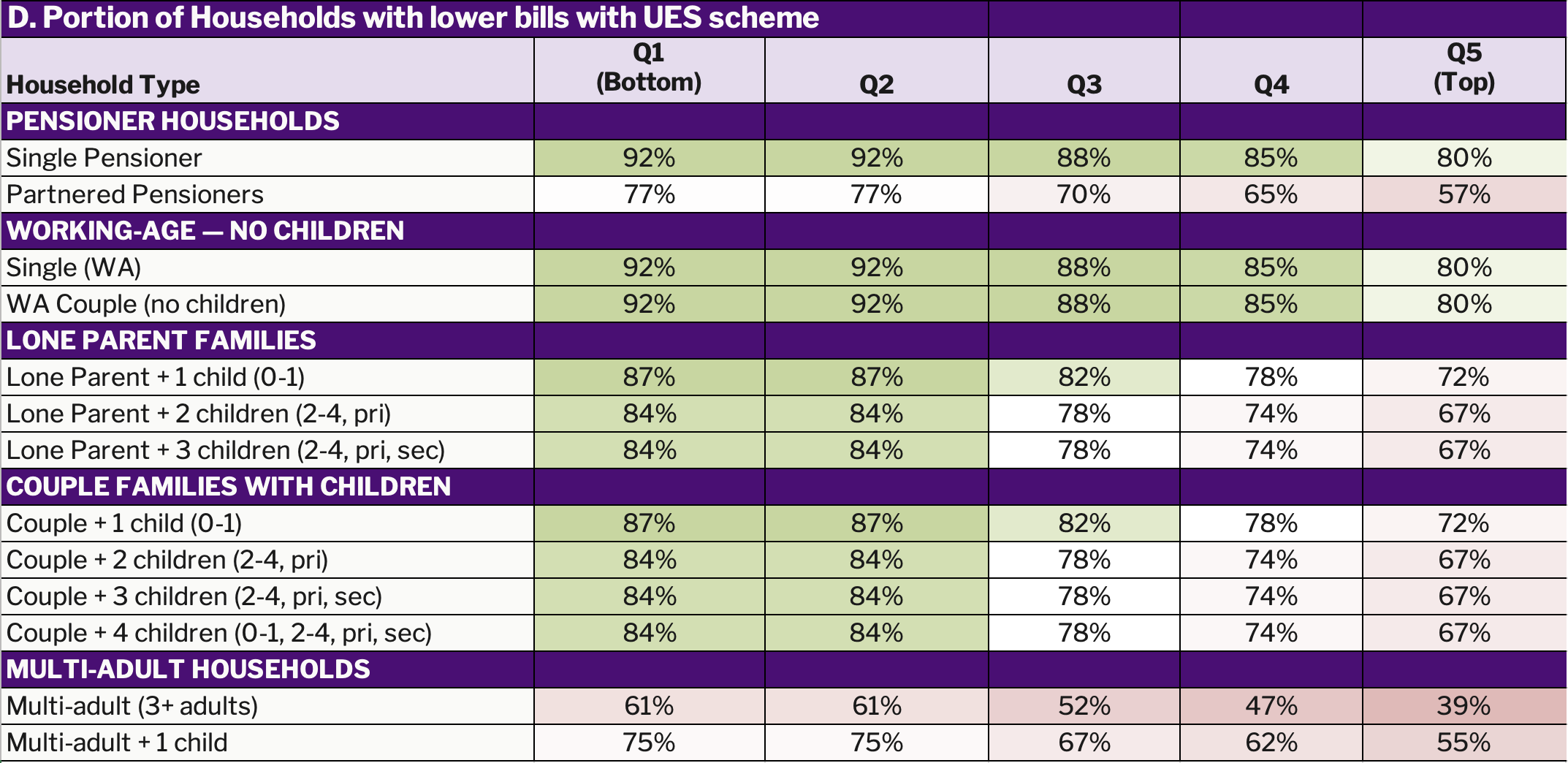
UES Effects within Typical Household Types

The Universal Energy Service could also be a contributor to overall national and planetary savings, using the model’s central case for demand response results in:

  • 3.7% reduction in domestic demand (15 TWh)
  • 0.8% fall in territorial emissions

Progressive levies

Because policy levies are in the consumption rates, households within the Free Tier pay no network costs, no policy levies, and no wholesale energy costs. Policy levies remain in the unit rate for above-tier consumption, but their distributional impact is transformed: they operate as a progressive charge on discretionary consumption rather than a regressive flat tax on essential energy use.

Detail

Standing Charges

The universal part of the Energy Service is to remove all standing charges from domestic bills for all households. Standing charges are regressive and penalise frugality.

About 80% of standing charges are used to cover network and system costs over which households have very little influence, and which include levies to compensate for the costs of transition. These are national costs where the decisions are made through national policy. This portion of standing charge revenues are replaced with direct funding from national taxation to directly fund the network and system transitions that are decided nationally. This is budgeted at £9 billion a year from the start of the Energy Service.

The remaining 20% of standing charges cover supplier’s overheads and administration, and suppliers are required to recover those costs through usage charges.

The purpose is to place the cost where the strategic decisions are taken, so that the body accountable for those decisions is also exposed to their cost and is therefore under continuous pressure to reduce it. The funding carried on the public account is not a standing subsidy. As the system is reformed, the costs of intermittency and of maintaining secure capacity should be progressively assigned to those whose choices create them, rather than held permanently on the taxpayer.

Usage and Free Tiers

A Free Tier of energy use provides the possibility of substantial reductions in the basic cost of living and incentivises reductions in energy use. Accessible to every household, the Free Tier would be set at two thirds of an “anchor” (initially set to 13,800 kWh a year, recalibrated annually), plus another 15% for each child in the home (up to a maximum of 2 children).

The introduction of the Free Tier will make no difference to the bills among households that consume energy at the average level. Progressive pricing allows energy providers to bill more for usage above the Free Tier to generate revenues equivalent to pre-UES levels. Energy suppliers will not be permitted to charge lower rates for higher use above the average.

This part of the Universal Energy Service is designed to have no fiscal impact, as the costs of the Free Tier supply are recouped by the suppliers in their charges for above Free Tier use. It is effectively an intra-household transfer between high users and low users.

Efficiency and Off Grid Fuels

Across the UK there is considerable overlap between the most inefficient housing, rural locations, and use of alternative fuels for heating due not having a gas-grid connection. To address these circumstances, the Universal Energy Service includes alternative allowances.

Poorly insulated homes

Housing with a category E+ rating for efficiency is allocated 100% of the Free Tier anchor (13,800 kWh at start). This continues until either the Energy for the Future programme can improve the rating to D or better, or the improvement offer is declined.

Off gas grid homes

Homes off the mains gas grid can elect to receive the gas component of their Free Tier as a voucher redeemable from a fuel supplier to their home, or to take the whole Free Tier in electricity.

Caps and Values to Households

The multiplier for above Free Tier use is capped at 4, above which the government would backstop the shortfall through a direct payment to suppliers for the difference between the 4.0x cap and the multiplier revenue neutrality would require.

Changes in retail prices change the value of the programme to households without increasing the Exchequer cost. Annual recalibration of the Free Tier anchor protects against demand shape changes pushing the multiplier up. See Appendix for details with analysis of elasticity effects.

Relation to Other Policies

The Universal Energy Service is the consumer part of the Prosperity 2030 programme’s aim to centralise energy system costs and benefits that belong at the national level. The commercial and industrial complement to this policy is the GB Energy Network policy, which moves energy network and system costs for business to a national responsibility.

The Universal Energy Service should be viewed in partnership with the Energy for the Future policy, which is coordinated to mitigate the energy inefficiency of the UK housing stock.

Published 18 May 2026