Generating the resources to strengthen reciprocity and build resilience.
Total New Revenues
£101 Billion / year
National Contributions + Property Tax + APD
From benefits to Services
£16 Billion / year
Redirecting spending to Universal Services
Total New Revenues
3.8% GDP / year
National Contributions + Property Tax + APD
When policy is deliberately designed to foster the connection between contribution and benefit, the result is reciprocity. Revenues in the Prosperity 2030 programme fund the Universal Services that drive down the cost of living, and the Structural reforms improve the efficacy of collective action. As permission to collect the contributions follows the benefits, Revenues are sequenced to stand on increases in confidence as the programme advances.
The two main pillars of revenue are reforms to taxation of incomes and property, which generate 93% of all new revenues. The natural assignments of those revenues are to national and local priorities respectively. Although not specifically hypothecated that way, the overall programme assigns all Property Tax revenues to fund local services.
The programme earns the right to create fiscal space (for priorities not assigned in P2030) gradually over the course of five years, by delivering increased benefits as new revenues are raised. In the first year 97% of new revenues will be spent, tapering down to 78% by the end of the fifth year.
Detail
Tax Primer
Progressivity
The importance of progressivity in taxation rises in line with inequality, partly by actuarial necessity and party to secure consent. This leans towards taxing incomes, as they are the most amenable to progressivity of the three major tax sources.
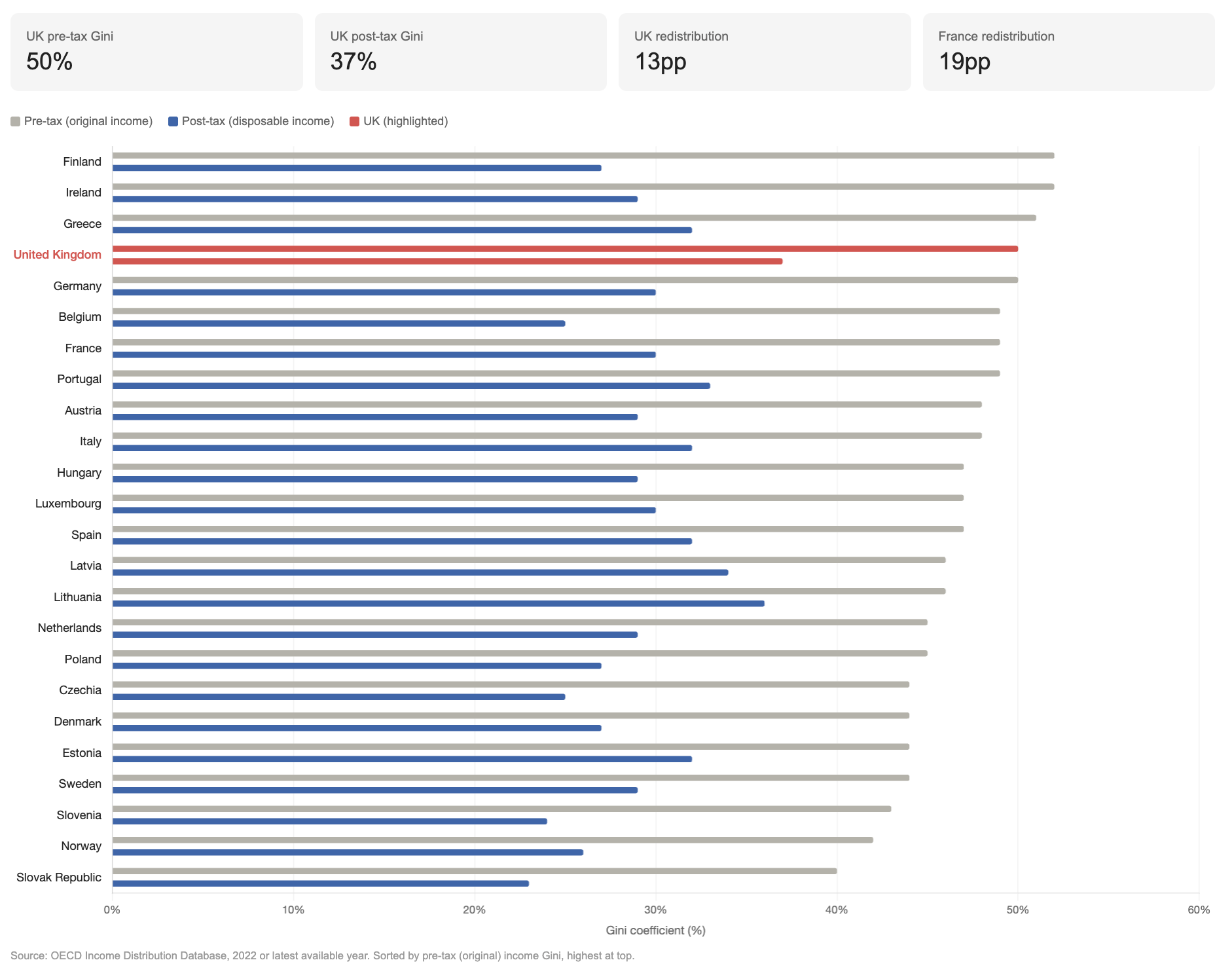
The UK is ranked third among European countries for pre-tax inequality and first for post-tax inequality (see GINI chart1). This supports making progressivity an important feature of UK tax reforms.
Flows and Stocks
There are three sources of revenue for collective action: taxing what people receive, what they spend, and what they have. The first two tax flows and the last taxes a stock.
Flows are continuous and provide reliable revenues over time without depleting future flows, and therefore future revenues. Moreover, receipts and spending involve transactions which provide a clean, crystallising event at which to apply a tax.
Progressive Taxation
Receipts can be progressively taxed easily because the income transactions that form the basis of the tax can be temporally lumped together to identify an individual within the distribution of their group at a point in time.
It is less straightforward to tax spending progressively. To do so would require one of two mechanisms: either the spender is identified by their income or wealth at the transaction (with each person paying a different price for the same item/service), or the item/service being purchased is accurately attributed to a point in the distribution. However, as both rich and poor purchase the same basic ingredients for life, attributing basic items and services to a point in a distribution is always wrong, with only limited progressive potential at the most extravagant end of spending.
Asset and Property Taxation
Taxing what people have, their stock or assets, presents a number of challenges. First, until an asset is transacted, any valuation is subjective. Second, the value can change dramatically over time. Third, the stock does not produce the liquid value required to pay a tax. Fourth, if the tax rate is higher than the rate of increase in the value, the tax base erodes as the tax is applied – resulting in ever reducing revenues (reverse compounding). Fifth, stock values can result from savings, accumulation, inheritance, windfalls, appreciation or, most likely, some combination of those. Sixth, appreciation in line with inflation is not real wealth. These factors limit effective taxation of assets to low rates that can be reasonably considered to be within the flow of value arising from those assets – otherwise there is nothing to pay the tax with. This explains why typical property taxes are about 1% across the OECD2. For all of these reasons, asset taxes (often called ‘wealth’ taxes) are not a reliable long-term source of national revenues, despite their simplistic popular appeal.
Property Tax
This report does propose a tax on property values, with a low rate (1%) and deferral provisions, to facilitate the transition from per-person Council Taxes. In the last 25 years, earnings grew 37% in 25 years, while house prices grew 150%3, and the P2030 adopts a Property Tax as a more effective method for the nation to capture this than a direct tax on wealth.