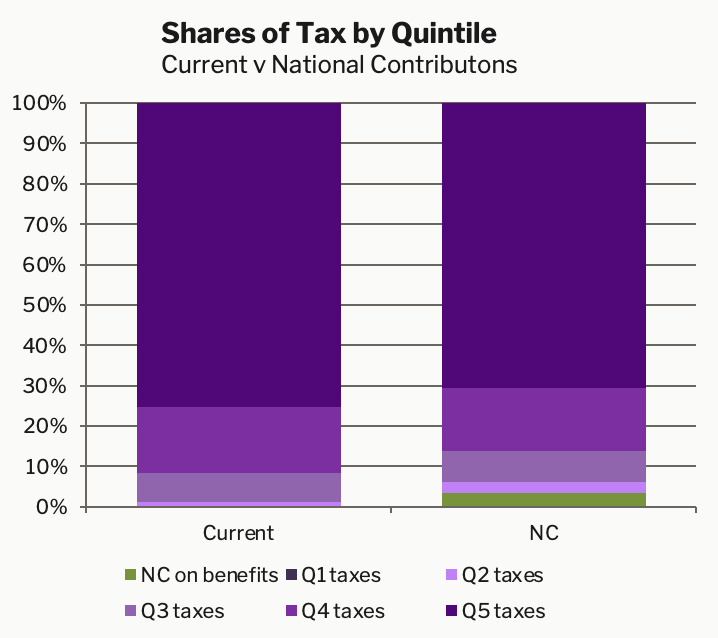
There are two primary reasons to apply National Contributions (NC) to benefit incomes (excluding disability benefits):
- Everyone is a recipient of the programme’s benefits, including the Universal Services, structural reforms, and the capacity to tackle currently unmet national priorities.
- Universal Services deliver greater value than cash redistribution, so the cost of living reductions are greater.
The contributory principle applies when the social contract delivers on its side of the bargain. Taxing cash benefits involves the exchange of discretionary power in return for public goods, just as it does for those paying higher taxes on their incomes. Solidarity, cohesion, and the elimination of stigma are all served when the contributions are as universal as the advantages.
Applying NC to benefits allows the contributory principle to be implemented with the same progressive rate structure, applying much lower rates for those on lower incomes.
As Services are more effective in reducing the cost of living, it makes sense to reallocate public spending from cash distribution (benefits) to Universal Services once the services are in place. This will be achieved by the gradual application of NC to benefit incomes at source.
Starting one year after NC and all the Universal Services have started, benefit incomes gradually become subject to NC tax at source over three years, such that by Year 5 all taxable (disability excluded) benefits are subject to NC.
Family Protection
A per-child allowance is applied to benefits income, reflecting the way benefits are calculated based on household composition. The allowance is the same as the VNC threshold, and only benefits income above the combined threshold is subject to NC. So a family with two children would have to receive more than £25,140 (2 x £12,570) in benefits before any tax would be withheld at source.