
This report imagines a five-year programme executed over a new Parliament, recognising that a new political mandate is required to engage in the programme.
At each step new revenues will be raised, initially through duties and then from incomes and property tax reforms, to fund access to services that are widely consumed and reduce the cost of living for as many as possible.
Preparation
Much of the first year will be spent preparing legislation and systems required to enable the remainder of the reforms and establishing the foundations needed to launch new services in the following year.
Key to the programme are reforms to:
- Incomes taxation
- Local taxes
- Digital services and identification
- Utility sector governance
- Local governance
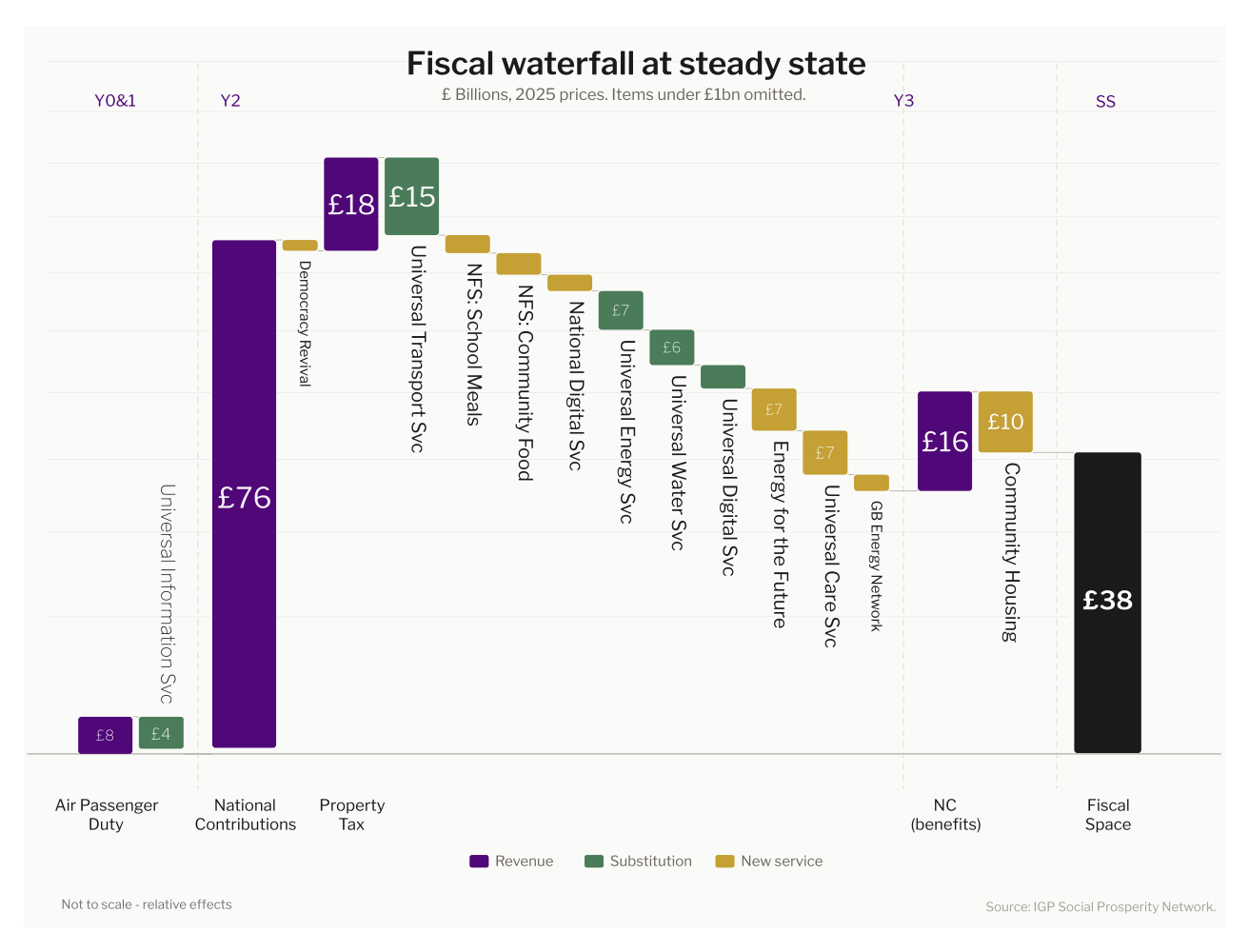
Phase1: Kick-off
The programme starts with nationwide changes that signal a substantial commitment of the society to the support and protection of all citizens:
- Free local buses
- TV Licence fee abolished
- Service Hubs
- Universal free schools meals in primary schools
Transport
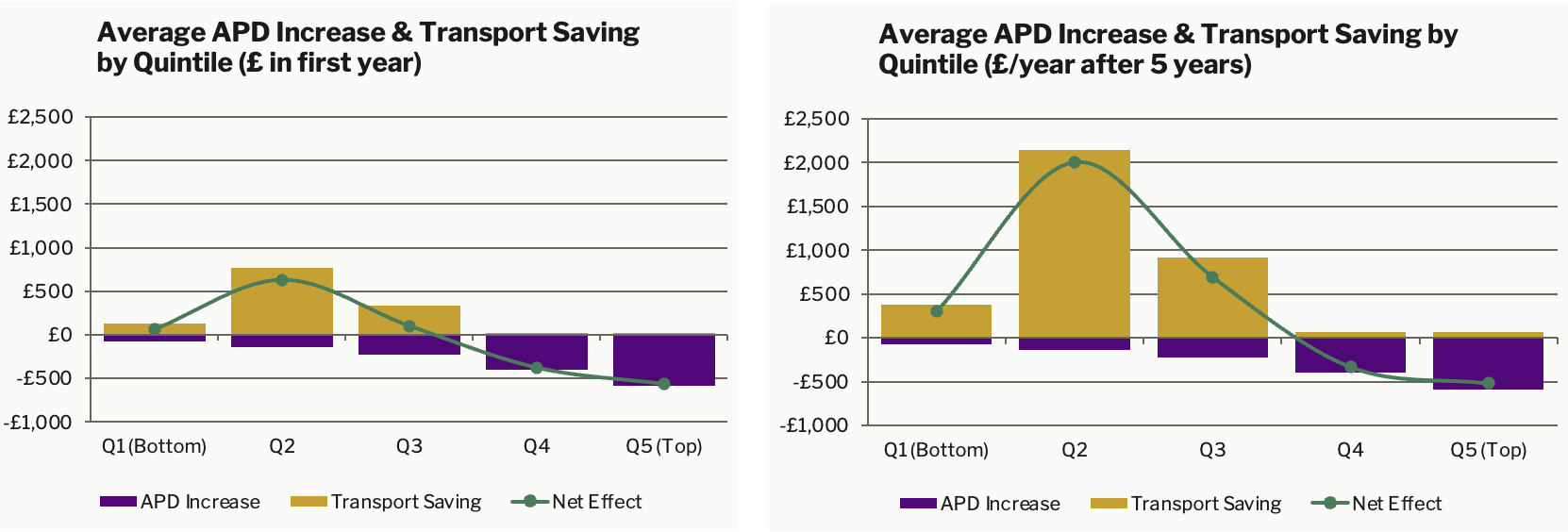
Free access to existing local bus services nationwide, will be paid for by taxing flying (tripling Air Passenger Duty, and extending VAT on aviation). This can be started almost immediately with changes to existing duty and VAT rules and will be broadly felt across the country. The effects are aggressively progressive, with frequent bus users seeing a £1,500/year reduction in transport expenses. The increased taxes are also progressive, with higher income groups taking more and longer flights, so tax rises are six times higher in the top quintile than bottom quintile. (Doubling local bus services over five years is included in the full programme.)
In any year half the country doesn’t fly, and 66% of the remaining flyers are better off, so 83% of people will save in any given year.
Information
Making the BBC a specifically Universal Information Service signals a new commitment to public goods and immediately reduces the cost of living for every household with a TV. The TV Licence is abolished and BBC revenue moves to direct funding, saving households £180 a year. The TV Licence Fee reserve fund (TV Licences with less 1 year to maturity) is used to kick-start the National Food Service (NFS), including the first publicly funded and independently operated community restaurants.
Food
In Year One, the National Food Service (NFS) launches with new services in all three channels: school meals, community food centres, and participating venues.
Universal free school meals are introduced for all primary school children. Approximately 590,000 – 640,000 children in years 3–6 who currently pay for school meals become eligible for free provision. An estimated one million children are expected to switch from packed lunches to school meals, raising primary take-up from approximately 65% to 85%. (Children in reception to year 2 are already covered by Universal Infant Free School Meals, and London primary school children are covered by the Mayor’s programme.)
Trials of free meals through participating venues will also begin, alongside the rollout of Digital ID with “tap-to-pay” equivalent functionality.
The cost to the National Food Service (NFS) in the first year is funded from the TV Licence Fee reserve fund created by the Universal Information Service.
Service Hubs
Also during the first year, local governments will be provided with grants to establish Service Hubs by adopting existing community food outlets and other facilities (of which there are estimated to be 500 nationwide). These will be staffed facilities using existing buildings that provide space for community gatherings, meals, Digital ID assistance, and sign posting for local services. They will also serve to reinforce confidence that the programme is real and widespread.
Digital ID
Seamless identity verification paired with enhanced privacy protection is a core function in any modern, large-scale society. Otherwise, it would be impossible to provide the essential guarantee of security and safety that is at the heart of the social contract.
The P2030 programme includes funding to build and maintain a reliable national infrastructure that will enable citizens to identify themselves with the minimum exposure of their private information. Digital ID also provides every holder with the tools to encrypt their private information securely, and restore control of their privacy online.
The objective is to move as quickly as possible to ‘tap to identify’ functionality that works the same way, using the same terminals, as tap to pay. The UK is already launching the GOV Wallet with early access in 2026 and that initiative should have made sufficient progress by 2030 to be within touching distance of this objective.
Phase 2
As confidence, experience, and capacity builds, new services will be added to coincide with tax reforms, such that increased tax contributions are offset by reductions in the cost of living for the majority of taxpayers. The objective is to build public confidence and strengthen the social contract, so most of the new revenues from tax reforms are used to reduce the cost of living.
Because larger shares of the lowest incomes are spent on accessing basic services and utilities, the combination of expanded Universal Services for basic needs with progressive taxes will have highly progressive distributional impacts.
And because Universal Services reduce the cost of living by between 11% and 69% more than the equivalent cash distribution, the efficiency of expenditures on services will offset more of any tax increase than cash benefits would. On average across the funded Universal Services in this policy programme, the greater efficiency is 27%. The Transport and Information services introduced in the first year have 29% and 31% efficiency respectively.
Tax reform
Taxation of incomes is simplified to flatten the definition of incomes to include all received income (with allowances for tax-sheltered National Savings accounts and capital gains adjustments for inflation) replacing IT, employee and self-employment NICs, Inheritance, Dividend, and Capital Gains taxes with a new National Contributions tax. This effectively reduces tax on wages relative to unearned incomes and dramatically simplifies the system, setting up a more obvious reciprocal link between contribution and access to Universal Services. Due to lags in implementation, additional revenues from the new tax will increase over the parliament, with two-thirds of the steady state available at the start.
Universal Digital Service
As soon as the vendors can make themselves ready, a transferable digital service voucher is available for everyone school-aged or older. The voucher saves every person £132 a year on average. Citizens can choose their own vendor. Any vendor that accepts is required to deliver a perpetually persistent minimum service that includes 30 mins talk/30 texts/30MB data daily, unlimited traffic to GOV.UK and BBC online services, plus a smart device. The programme models this as starting in Year 2, after a year of preparation to coordinate registration and billing systems.
A separate National Digital Service will build out secure, distributed communications and data centre capacity to support a digitally-enabled society. With privacy protection at its heart, this is vital, sovereign infrastructure that supports the UK economy, public services, and national security.
Universal Service Expansions
New Universal Services are added which reduce the cost of living by between £500 and £5,000 a year per household.
There are two parts to these reforms:
- Relocating core network costs from bills to central funding, and;
- Reductions in household bills tied to demand moderation.
The portion of standing charges related to core infrastructure costs for energy and water are moved to general tax revenues, opening the way for structural governance reforms of those utilities. The GB Energy policy enables the transformation of the energy grid, and the creation of a Universal Water Service opens the way for transition to Catchment Water Service Operator1 management of water.
Households can reduce their energy bills through mandated free usage tiers, which suppliers recoup from higher use customers.
The rapid rollout of cost-effective upgrades to home heating and energy efficiency through the Energy for the Future policy will prepare the nation’s housing stock for the future.
Democracy Revival
New local elections will be held to select Councillors who are well paid and supported, laying the groundwork for expanded local funding and budget responsibilities.
Community Food Centres
Grants are awarded to independent community operators to run local social restaurants. These may be standalone, or combined with Service Hubs and Skills Centres. They will have core obligations to provide nutritious meals free of charge, five days a week, and can add additional services as they see fit. The target is to recruit 1,500 CFCs in the second year of the programme.
Phase 3
Various complementary reforms can be phased in over three years to accommodate practical constraints on capacity expansion.
Transport
The national network of free bus services is doubled to provide an effective guarantee of access to all the other services, with 80,000 drivers hired to drive an additional 35,000 buses from 450 new depots. All capital is fully funded inside the programme without debt.
Food
Today’s public food programmes, such as schools and the military, already provide 1.3 billion meals a year. That will be doubled over the course of P2030’s rollout using different channels; the centrepiece being universal free school meals with year round coverage. Funding will be provided for 9,000 independently operated Community Food Centres, allowing to operate five days a week and serve one million meals a day. Using differential take-up rates across income distributions, we model the gradual establishment of a programme that delivers seven million meals a day: 62% as school meals, 25% meals in Community Food Centres, and 13% through participating venues, including a combination of restaurants, peer groups, charities, colleges, and other institutions. Cost of living displacement is 34% more efficient than cash on a per-meal basis.
Benefits Reallocation to Services
Two years of highly progressive distributional effects of Universal Services, amplified by efficiency, will allow for the reallocation of some cash benefits (6%) to services through the gradual application of National Contributions to benefit incomes. Phased in over three years, the loss of cash benefits is more than offset by the value of the services that the reallocation funds.
Property Tax Reforms
Council Tax and Stamp Duty are gradually replaced with a property value tax without negatively impacting disposable incomes in the large majority of property owners, and with protections for all homeowners. Reductions in the cost of living from Universal Services open the door for desperately needed reforms of property taxation, and generate sufficient revenues to fund greatly expanded local social care provision.
Social Care & Housing
The programme funds the development of more public housing, including new build, shared housing, and repurchased housing stock (see Right to Sell).
Housing with shared facilities fills in where markets fail, and is expected to deliver 100,000 units a year. This is housing designed to be suitable for many different stages in someone’s life: when they are moving or relocating; entering the labour market for the first time; experiencing a family disruption; growing older or approaching the end of their life; or in need of emergency relocation.
Community social care funding is increased by £7 billion a year as a down-payment on structural reforms that will, by 2030, have been proposed by the Casey Commission.
Palliative care and hospice facilities receive an extra £1 billion a year through the Right to Life policy.
The End Result
At the end of this prototype five-year programme, life in every UK community will have been transformed. The cost of living for every citizen will have been reduced. The social contract strengthened with a visible and tangible increase in public services for everyone in return for their contribution. The physical fabric of a resilient society will be woven into every corner of the country — all with zero additional borrowing.
The model shows that revenues will exceed costs by £100 billion over the course of the roll-out. This will provide enough flexibility to adjust for any variations in implementation expenses and revenues.
Everyone in the UK will have access to online information and services, will be able to get to work locally, eat healthy meals in their community, and could have an energy bill of zero if they reduce their consumption. No conditions, no qualifications, no means testing.
In addition to every postcode having at least one new community facility, the average household in the two bottom quintiles will have reduced their cost of living by more than £1,500 a year, even with the increases in taxation.
Social care, community housing, and hospices will have £9 billon a year of additional funding. Councils will be run by newly elected, well-paid and supported councillors, with control over local budgets for Universal Services and discretion to fund additional services.
National management of energy, water, and digital reformed, and enabling the country to build the infrastructure needed for the challenges of transition and mitigation that are looming on the horizon.
A foundation of strong reciprocity will have been established, which connects the value of citizenship to contribution. Local capacity and democracy will be greatly strengthened with stable long-term funding and meaningful control over local character.
A nation transformed from scared to safe. A citizenry converted to the power of collective action. Life lived larger in every corner of the country. From this platform, it is possible to imagine a society willing and able to tackle the great challenges of the future. And P2030 creates the fiscal space to do just that.