
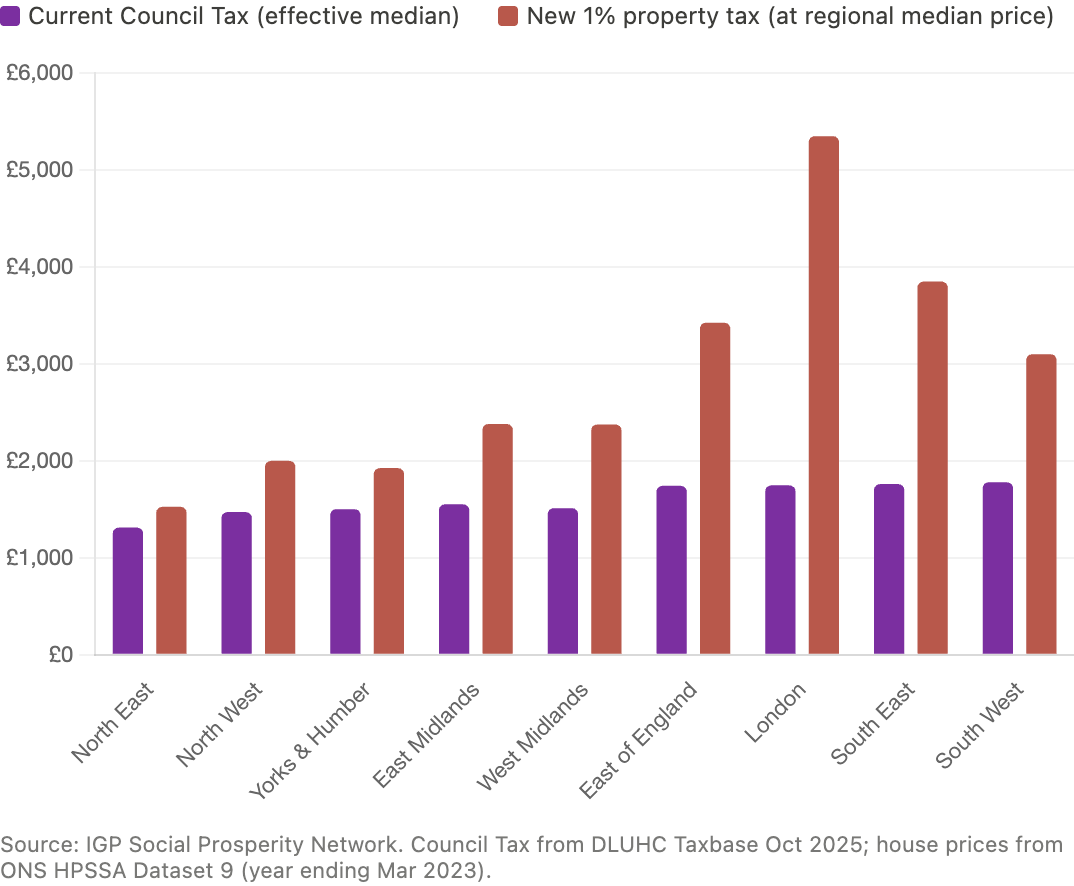
The increase in tax as a result of the move from Council Tax to Property Tax varies significantly across the country, with areas where property prices are low seeing small annual increases of a few hundred £s. However, in the South East of England the picture changes dramatically with much higher property values creating much larger Property Tax liabilities: averaging £3,600 a year in London and £1,800 across the South outside London. These effects are to be expected when reversing a regressive tax that varies much less across the country, despite large disparities in property values and wealth.
The distributional modelling of the Universal Services and new taxes generates a cost of living savings of £2,000 a year on average across households in the lower three quintiles of incomes. This population own about 46% of all private properties and the US savings would cover the increased Property Tax in many instances.
Households with incomes above the 60th percentile are modelled to make net additional contributions, with Universal Services only offsetting a portion of the new taxes. For these households, the increases in Property Tax will arrive as an additional burden. The Property Tax design includes provisions that allow deferral of all or part of this additional expense, and it is assumed that all owners with insufficient income will make that election. The central estimate is that approximately 2.5 million households will defer - see Deferral appendix.
Conclusion
Property ownership is unevenly distributed across the income range, skewed heavily to those with the highest incomes, and property values are unevenly distributed across the country, skewed heavily toward the South and London in particular. Even then, the ratio of values to incomes escalates steeply from North to South, so incomes do not to keep up with higher property values.
The reality is the effects of the Property Tax will diverse and particular, and that is why the deferral mechanisms incorporated into the design are important.
The distributional effects are not incorporated into this report, on the basis that those who need to, or want to, will take advantage of deferral, and others will reduce their other costs of living by using more Universal Services. So the effects cannot be usefully attributed to either household types or income quintiles.
The overall effect of all the property related reforms are more likely to exert downward pressures on house prices, see Property Tax, Stamp Duty and house prices appendix.