
There are principles of policy design in the P2030 programme that run counter to established social contract arrangements in most developed countries. Below are the most important contrarian principles incorporated in P2030.
Universal
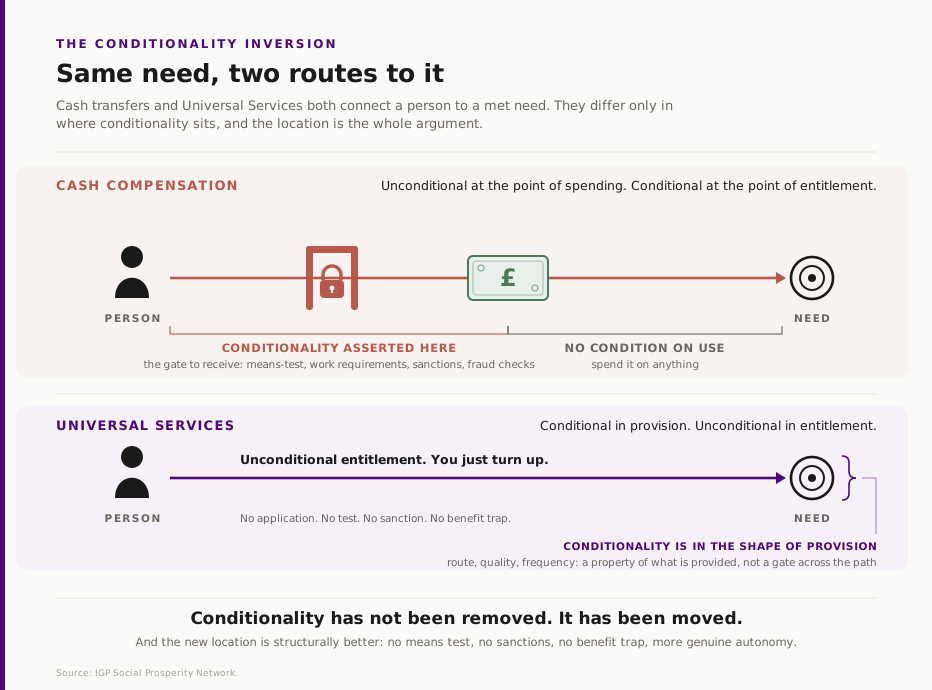
A core design principle is universality. Recognising the social contract as equally binding on all citizens is a foundation for reciprocity. Each citizen is taken as equally entitled to collectively provided safety, security, and services, and equally bound to make contributions from their incomes.
The temptation is to ‘target’ collectively provided support, which assumes that the need is already present and that the administrator can identify it. Creating real safety defies both conditions: the safety is knowing that the support is immediately available if and when needed, without arbitrary external evaluation.
The state is incapable of fair or timely judgement. And any conditionality, beyond needs, erodes the credibility of the state as a counterparty to the social contract. Consciously or not, it introduces in the citizen a notion that contribution is also conditional.
From a practical perspective, taxes apply to everyone and the benefits of the collective action they enable must be accessible by everyone.
Basic
The definition of needs has bedevilled philosophical and policy frameworks and presents a practical hurdle for the design of collectively provided support. The design principle adopted in this report is to establish a criterion where a need is defined as what an individual needs to fully participate in their society – mirroring the framework adopted in the Institute for Global Prosperity’s original Universal Basic Services report1. This represents sufficiency, aligned with safety, not satisfaction.
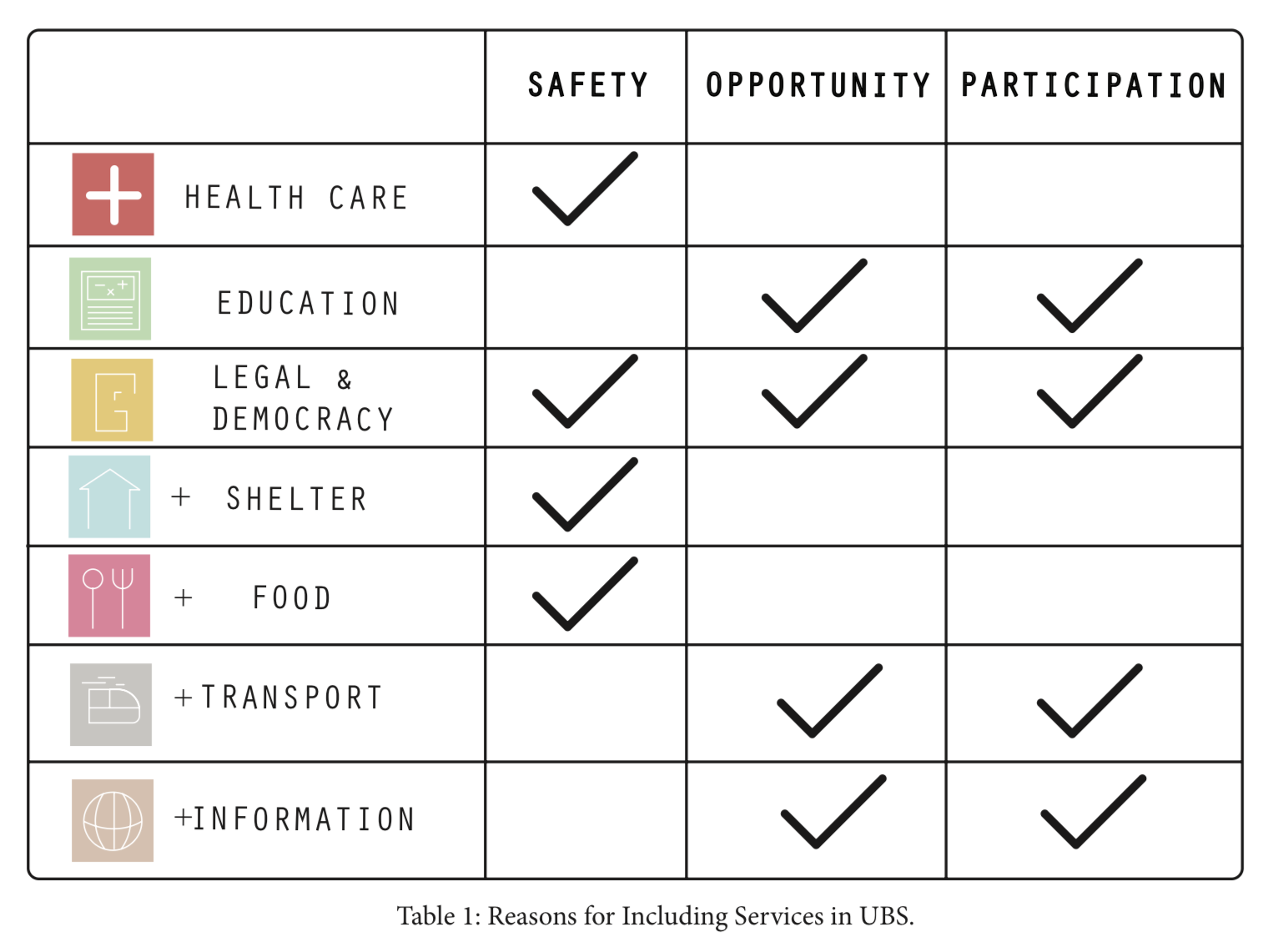
This simplifies the definition of needs and establishes a criterion for inclusion. The physiological needs for shelter, sustenance, and care, join the enabling services of education, information, and transport to form six basic services. To those, a broad institutional framework is added to protect freedoms, facilitate participation, and organise at scale, as the seventh service category – labelled as Legal & Democracy.
Services
The social contract is better described as a promise. At its core, it cannot be expressed in purely monetary terms. It is a promise to help, bound by a mutual responsibility to seek it only when it is needed, and to provide it when requested.
That promise has become entangled with cultural norms that equate relative worth with material consumption, and that has allowed political expediency in the delivery of the social contract. Distributing cash appears to satisfy the ego of the responder and the requester, without any commitment to actually meet the real need.
Compensatory cash redistribution may be relatively easy to implement, but it has failed to fulfil the social contract. It is mechanically impossible to leverage for efficiency, and assumes the existence of perfect markets for need-satisfiers. The practice is a vestige of the rapid expansion of the population included in the social contract, and has created a deep-seated division between donor and applicant.
Actually building the physical and social structures that make the promise of the social contract a reality requires more effort, more collaboration, and a deeper mutual respect than simply handing out cash. The P2030 programme takes this responsibility to heart.
Broad access lends leverage to the collective provision of need-satisfiers, without entailing centralised provision. It is in the commitment to make a satisfier accessible, and to do so independently of markets, that the economies of scale and reductions in friction come to the fore. Services are uniquely able to leverage these efficiencies, allowing a programme like P2030 to deliver far greater reductions in the cost of living than the services would cost to make available (1:1.2 in P2030).
Reciprocity
Reciprocity requires the removal of obstacles to contribution, effort, and work, without preconceived ideas of the value of any individual’s contribution. It is beyond the capability of any state, or any individual, to pre-judge the contributions that any person may make over their lifetime. The decisions and motivations of individuals are theirs alone. What society can do is smooth the way for contributions based on individual motivation and aptitude. Public policy creates conditions on the basis, and expectation, that those conditions will encourage citizens to flourish, knowing full well that the actual flourishing is a private matter.
Resilience
The overarching objective of this policy programme is to create a resilient society that flourishes within the boundaries of the planet we inhabit. That requires social and physical infrastructures that withstand sudden changes in the capacities and capabilities of individuals so that when a financial or other crisis hits, the basic functions of society continue to work. It shifts society from individual fragility to collective resilience.